segunda-feira, 6 de abril de 2015

Regiões Vinicolas Portuguesas


Portugal possui as seguintes regiões vinícolas:

Alentejo
Algarve
Dão e Bairrada
Douro
Estremadura
Ilhas Atlânticas
Ribatejo
Setúbal
Vinhos Verdes


Portugal é um país de longa tradição vinícola, iniciando sua história com a implantação da vinicultura pelos romanos, muitos séculos atrás.

A vitivinicultura portuguesa demorou a evoluir tecnologicamente e, por muito tempo, produziu poucos vinhos de alta qualidade. Nas últimas duas décadas, como conseqüência do importante desenvolvimento econômico, político e social do país, a vitivinicultura portuguesa experimentou grande evolução, particularmente no campo tecnológico.

Fato importante é que essa modernização foi realizada sem descartar os aspectos tradicionais positivos, como por exemplo, a utilização de variedades de uvas autóctones e tradicionais. Com ajuda da tecnologia, essas castas, que antes originavam vinhos de qualidade inferior, passaram a dar grandes vinhos, aperfeiçãondo suas características ímpares.

Portugal enfrenta a globalização de estilos e preferências de consumo investindo na preservação das características e tradições dos bons vinhos portugueses.

Nos últimos anos, com a instalação do Mercado Comum Europeu, o vinho português ampliou sua busca por qualidade e visibilidade internacional, conquistando uma posição merecida pela qualidade e diversidade de seus vinhos.

Diversos enólogos portugueses despontam como artistas no cenário mundial, com vários rótulos Top ganhando prestígio internacional e ocupando um merecido espaço reservado às estrelas.

Recentes mudanças na regulamentação impulsionaram novo valor aos Vinhos Regionais, situados entre os vinhos básicos e os classificados, que apresentam uma ótima relação custo-benefício, tornando-se cada vez mais competitivos pela associação com a personalidade marcante dos vinhos de Portugal.

Classificação dos Vinhos Portugueses

Os vinhos portugueses estão classificados em quatro níveis de qualidade:

Vinho de Mesa
Vinho quenão se enquadra em nenhuma das classificaçõesmencionadas a seguir, cuja produção pode ser feita em qualquer região do país . Não podem ter no rótulo nenhuma referência a uma região de produção ou a variedades de uvas.

Vinho Regional
Vinho de qualidade superior ao vinho de mesa, produzido com, no mínimo, 85% de uvas provenientes da região especificada. Hoje existem muitos vinhos regionais de qualidade igual ou superior à de vinhos DOC, havendo inclusive alguns bons produtores que, por não concordarem com as regras impostas pela comissões reguladoras dessa categoria, passaram a rotular seus vinhos como regionais.

Vinho de Denominação de Origem Controlada (D.O.C.)
Teoricamente é a categoria de mais alto nível de qualidade e identifica o vinho produzido em região delimitada, sujeito a regras mais restritas quanto à procedência e variedades de uvas utilizadas, o método de vinificação, o teor alcoólico, o tempo de envelhecimento, etc. Equivale à AOC francesa, à DOC italiana e à DO espanhola.

Vinho de Qualidade Produzido em Região Determinada (V.Q.P.R.D.)
Para atender ao Mercado Comum Europeu foi criada a nomenclatura Vinho de Qualidade Produzido em Região Determinada (V.Q.P.R.D.) que engloba as IPR e as DOC. Também foram criadas denominações análogas para os vinhos espumantes e licorosos: V.E.Q.P.R.D. (Vinho Espumante de Qualidade Produzido em Região Determinada) e V.L.Q.P.R.D. (Vinho Licoroso de Qualidade Produzido em Região Determinada).


Fonte: www.academiadovinho.com.br

sábado, 21 de março de 2015

Pinot Noir do Oregon

Na última 5ª feira, dia 19 de março, realizamos no Rosmarino uma grande degustação, desta vez de vinhos norte americanos, produzidos com a uva Pinot Noir no estado do Oregon, tivemos a presença de 7 confrades. Foram degustados 7 vinhos, de safras diversas (2002, 2005, 2010, 2011 e 2012), O nosso confrade Marcio Guedes foi responsável pelo menu da noite.

Couvert: Pão italiano, mini-ciabata, pão de queijo, patê de roquefort, manteiga e azeitona.

Entrada: Salada de mini verdes com queijo de cabra e shiitake grelhados.

Primeiro Prato: Crepes abertos de queijo e nozes gratinados ao creme e parmesão

Segundo Prato: Coq au vin (com bacon crocante, cogumelos, cebolinha) feito com frango caipira desossado e arroz branco.

Sobremesa: Entremet de chocolate, Torta de nozes carameladas, Merengue de chocolate belga e avelãs, Carolinas de creme, Ovos nevados, Profiteroles, Terrine de Frutas, Tiramisú, Creme brulée, Pastiera di grano, Bavarese de chocolate e Tarte Tatin

Como de costume o serviço foi excelente e a execução do cardapio maravilhosa.

A degustação contou com sete vinhos com níveis de alcool variando entre 13,1% e 14,1%.


A seguir uma breve descrição dos vinhos degustados:

Archery Summit Premier Cuvee 2010
Produtor: Archery Summit
País/Região: USA/Oregon/Willamette Valley
Graduação alcoolica: 13.6%
Uvas: Pinot Noir
Confrade: Altman

St. Innocent Anden Vineyard 2002
Produtor: St. Innocent
País/Região: USA/Oregon/Willamette Valley
Graduação alcoolica: 13.9%
Uvas: Pinot Noir
Confrade: Alessandro

Argyle Nuthouse 2005
Produtor: Argyle
País/Região: USA/Oregon/Willamette Valley
Graduação alcoolica: 14%
Uvas: Pinot Noir
Confrade: Marcio

Domaine Serene Evenstad Reserve 2011
Produtor: Domaine Serene
País/Região: USA/Oregon/Willamette Valley
Graduação alcoolica: 13.1%
Uvas: Pinot Noir
Confrade: João Luis

Erath 2012
Produtor: Erath
País/Região: USA/Oregon/Dundee Hills
Graduação alcoolica: 13.5%
Uvas: Pinot Noir
Confrade: Joubert

Cloudline 2012
Produtor: Cloudline
País/Região: USA/Oregon/Willamette Valley
Graduação alcoolica: 13.9%
Uvas: Pinot Noir
Confrade: Ricardo

Domaine Drouhin 2012
Produtor: Drouhin Family Estates
País/Região: USA/Oregon/Dundee Hills
Graduação alcoolica: 14.1%
Uvas: Pinot Noir
Confrade: Calabro

Vinhos degustados


Os vinhos apresentaram cor rubi, sen que alguns apresentaram um halo granada mostrando a sua evolução. Os aromas predominates forma frutas vermelhas, como groselha e morango, alem de aromas típicos de um boa evolução.

Nesta degustação, os resultados do nosso painel apresentaram, uma ínfima amplitude de notas, sendo na média aparada de 0,8 pontos (de 88,9 a 89,7).

O vinho que ficou em último lugar foi o Cloudline 2012, produzido por Cloudline Cellars, na região de Willamette Valley no Oregon, com 13.9% de alcool.

O segundo melhor vinho do painel, foi o Domaine Drouhin 2012, produzido por Drouhin Family Estates na região de Dundee Hills no Oregon, com 14.1% de alcool, escolhido o melhor vinho por dois confrades e o segundo melhor por outro.

O Campeão da noite, foi o Argyle Nuthouse 2005, produzido por Argyle Winery na região de Willamette Valley no Oregon, com uma graduação alcoolica de 14%, ele foi escolhido o melhor vinho para dois confrades e o pior por outro.


Vejam os resultados completos abaixo.


Não se esquecam que no dia 16/Abril, quando degustaremos Tintos portugueses, fora Douro e Alentejo. Até lá....

Não percam a próxima degustação.


quarta-feira, 18 de março de 2015

Oregon wine

The state of Oregon in the United States has established an international reputation for its production of wine. Oregon has several different growing regions within the state's borders which are well-suited to the cultivation of grapes; additional regions straddle the border between Oregon and the states of Washington and Idaho. Wine making dates back to pioneer times in the 1840s, with commercial production beginning in the 1960s.
American Viticultural Areas entirely within the state include the Willamette Valley, Southern Oregon, Umpqua Valley, and Rogue Valley AVAs. Parts of the Columbia Gorge, Walla Walla Valley, and Snake River Valley AVAs lie within Oregon. Pinot noir and Pinot gris are the top two grapes grown, with over 16,000 tons (14,515 metric tons) harvested in 2005. As of 2005, Oregon wine makers produced over 1.5 million cases combined.

History
Wine has been produced in Oregon since the Oregon Territory was settled in the 1840s; however, winemaking has only been a significant industry in the state since the 1960s. Grapes were first planted in the Oregon Territory in 1847. Valley View, the first recorded winery, was established by Peter Britt in the late 1850s in Jacksonville. Throughout the 19th century, there was experimentation with various varietals by immigrants to the state. In 1904, an Oregon winemaker won a prize at the St. Louis World's Fair. Wine production stopped in the United States during Prohibition. As in other states, the Oregon wine industry lay dormant for thirty years after Prohibition was repealed.
The Oregon wine industry started to rebuild in the 1960s, when California winemakers opened several vineyards in the state. By 1970, there were five commercial wineries, with 35 recorded acres (14 ha).
This included the planting of Pinot noir grapes in the Willamette Valley, a region long thought too cold to be suitable for viticulture. In the 1970s, more out-of-state winemakers migrated to the state and started to organize as an industry. The state's land use laws had prevented rural hillsides from being turned into housing tracts, preserving a significant amount of land suitable for vineyards. In 1979, Eyrie Vineyards entered a 1975 Pinot noir in the Wine Olympics; the wine was rated among the top Pinots in the world, thus gaining the region its first international recognition.
The accolades continued into the 1980s, and the Oregon wine industry continued to add both wineries and vineyards. The state industry continued to market itself, establishing the first of several AVAs (American Viticulture Areas) in the state. The state also grew strong ties with the Burgundy region of France, as Oregon's governor paid an official visit to Burgundy and a leading French winemaking family bought land in Dundee.
In the early 1990s, the wine industry was threatened by a Phylloxera infestation in the state, but winemakers quickly turned to the use of resistant rootstocks to prevent any serious damage. The state legislature enacted several new laws designed to promote winemaking and wine distribution. The state found a newfound fous on "green" winemaking, leading the global wine industry into more environmentally friendly practices. Several new AVAs were established. By 2005, there were 314 wineries and 519 vineyards in operation in Oregon. By 2009, the number of wineries in the state has increased to 453 and remains the 3rd largest wine producer in the country
Varieties of wine
Like other wines produced in the United States, Oregon wines are marketed as varietals. Oregon law requires that wines produced in the state must be identified by the grape variety from which it was made, and for most varietals it must contain at least 90% of that variety. The exceptions to the 90% law are the following varietals: Red and White Bordeaux varietals, Red and White Rhône varietals, Sangiovese, Tempranillo, Zinfandel and Tannat. For these wines, they follow the Federal guidelines of 75%. Oregon law has long forbidden use of place names, except as appellations of origin. Oregon is most famous for its Pinot noir, which is produced throughout the state. Pinot noirs from the Willamette Valley have received much critical acclaim from wine connoisseurs and critics, and Oregon is regarded as one of the premier Pinot-producing regions in the world.
Major wine-producing regions
There are, loosely speaking, three main wine producing regions with a major presence in the state of Oregon, as defined by non-overlapping American Viticultural Areas. Two of them—the Willamette Valley AVA and the Southern Oregon AVA—are wholly contained within Oregon; a third, the Columbia Gorge AVA straddles the Columbia River and includes territory in both Oregon and Washington; however, this AVA is considered to be an Oregon AVA. Portions of the Walla Walla Valley AVA, an area which is primarily in Washington (along with the Columbia Valley AVA which contains it), descend into Oregon in the Milton-Freewater area. The Southern Oregon AVA was recently created as the union of two Southern Oregon winegrowing regions long considered distinct, the Rogue Valley and the Umpqua Valley. Several other smaller AVAs are found within some of these larger regions.[14] The Snake River Valley AVA, which straddles Oregon's border with Idaho along the Snake River, is the first AVA to include a part of Eastern Oregon.[15]
Willamette Valley
The Willamette Valley AVA is the wine growing region which encompasses the Willamette Valley. It stretches from the Columbia River in the north to just south of Eugene in the south, where the Willamette Valley ends; and from the Oregon Coast Range in the West to the Cascade Mountains in the East. At 5,200 square miles (13,500 km2), it is the largest AVA in the state, and contains most of the state's wineries; approximately 200 as of 2006.
The climate of Willamette Valley is mild year-round, with cool, wet winters and warm, dry summers; extreme temperatures are uncommon. Most rainfall occurs outside the growing season and the valley gets relatively little snow. Not all parts of the Valley are suitable for viticulture, and most wineries and vineyards are found west of the Willamette River, with the largest concentration in Yamhill County.
The region is best known for its Pinot noir, and also produces large amounts of Pinot gris, Riesling, and Chardonnay. The region also produces Cabernet Sauvignon, Gewürztraminer, Müller-Thurgau, Sémillon, and Zinfandel grapes, but in far smaller quantities.
The region is divided into six subordinate AVAs: Chehalem Mountains AVA, Dundee Hills AVA, Eola-Amity Hills AVA, McMinnville AVA, Ribbon Ridge AVA, and the Yamhill-Carlton District AVA. In addition, many wine connoisseurs further divide the Willamette Valley into northern and southern regions approximately at the latitude of Salem.
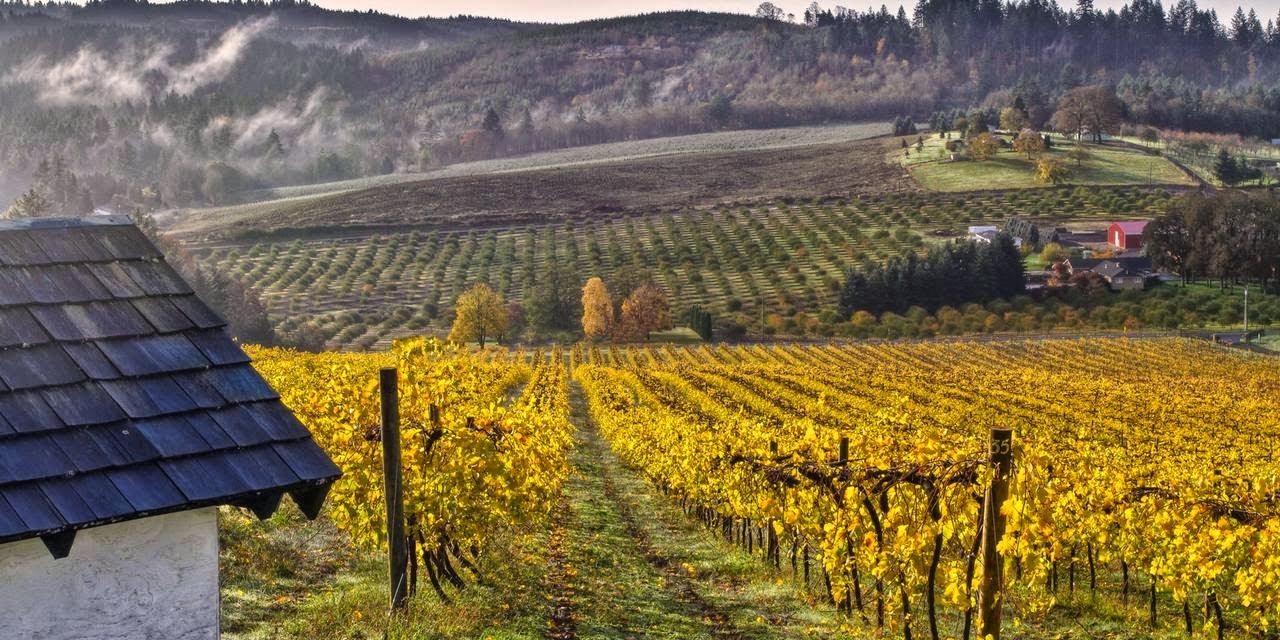
photo: BBC.com
Southern Oregon
The Southern Oregon AVA is an AVA which was formed as the union of two existing AVAs—the Rogue Valley AVA and the Umpqua Valley AVA. (A small strip of connecting territory is included in the Southern Oregon AVA to make it a contiguous region; however, this strip passes through mountains regions not suitable for vineyards.) This AVA was established in 2004 to allow the two principal regions in Southern Oregon to jointly market themselves. As the Rogue Valley and Umpqua Valley regions produce different grapes and different varietals, they are examined separately.
Umpqua Valley AVA
The Umpqua Valley AVA contains the drainage basin of the Umpqua River, excluding mountainous regions.[20] The Umpqua Valley has a warmer climate than the Willamette Valley, but is cooler than the Rogue Valley to the south. It is the oldest post-prohibition wine region in Oregon. Grapes grown here include Tempranillo, Baco noir, Pinot noir, Pinot gris, Cabernet Sauvignon, Chardonnay, and Riesling, Grüner Veltliner, and a host of lesser known Vitis vinifera. The region includes two sub-AVAs, the Red Hill Douglas County, Oregon AVA, a single vineyard AVA, as well as the Elkton, Oregon AVA, which was established in early 2013.
Rogue Valley AVA
The Rogue Valley AVA includes the drainage basin of the Rogue River and several tributaries, including the Illinois River, the Applegate River, and Bear Creek. Most wineries in the region are found along one of these three tributaries, rather than along the Rogue River itself. The region is 70 miles (110 km) wide by 60 miles (100 km) long (although much of the land within the AVA is not suitable for grape cultivation); there are currently 32 wineries with only 1,100 acres (4 km2) planted. The three valleys differ greatly in terroir, with the easternmost Bear Creek valley being warmest and driest, and the westernmost Illinois River valley being coolest and wettest. Each river valley has a unique climate and grows different varieties of grapes. Overall, however, this region is the warmest and driest of Oregon's wine-growing regions. The region has one sub-AVA, the Applegate Valley AVA.
Columbia Gorge
The Columbia Gorge AVA is found in the Columbia Gorge. This region straddles the Columbia River, and thus lies in both Oregon and Washington; it is made up of Hood River and Wasco counties in Oregon, and Skamania and Klickitat counties in Washington. The region lies to the east of the summits of nearby Mount Hood and Mount Adams, situated in their rain shadows; thus, the region is significantly drier than the Willamette Valley. It also exhibits significant differences in elevation due to gorge geography, and strong winds common in the area also play a factor in the region's climate. This allows a wide variety of grapes to be grown in the Columbia Gorge. The region has nearly 40 vineyards, growing a wide variety of grapes, including Syrah, Pinot noir, Chardonnay, Gewürztraminer, Zinfandel, Cabernet Sauvignon, Pinot gris, Riesling, and Sangiovese.
Walla Walla Valley
Portions of northeastern Oregon (in the vicinity of Milton-Freewater) are part of the Walla Walla Valley AVA, which was established in 1984. This appellation, which is part of the Columbia Valley AVA, lies primarily within Washington state. This region has nearly 100 wineries and 1,200 acres (5 km2) planted. Wines grown in the valley include Syrah, Merlot, and Cabernet Sauvignon, as well as Sangiovese and a few exotic varietals including Counoise, Carmenère, Mourvèdre, Cabernet Franc, Nebbiolo and Barbera.
A new AVA, The Rocks District of Milton–Freewater, was proposed in 2014.
Snake River Valley
A new viticultural area along the Snake River was established on April 9, 2007. Principally located in Idaho, the area also encompasses two large counties in Eastern Oregon, Baker County and Malheur County. The region's climate is unique among AVAs in Oregon; the average temperature is relatively cool and rainfall is low, creating a shorter growing season. Current production is led by hardy grapes such as Riesling, Gewürztraminer, and Chardonnay. The climate also lends itself extremely well to the production of ice wine. However, the AVA is quite large and warmer microclimates within the area can also support different types of grapes such as Cabernet Sauvignon and Merlot.
Source: www.wikipedia.com

sábado, 21 de fevereiro de 2015

Chablis vs Pouilly-Fuissé

Na última 5ª feira, dia 19 de fevereiro, realizamos no Rosmarino uma excelente degustação de vinhos brancos da região da Borgonha: Chablis vs Pouilly Fuissé, produzidos a partir da uva Chardonnay nas sub-regiões de Chablis e Pouilly-Fuissé, esta segunda, na vizinhança de Macon. Tivemos a presença de 8 confrades. 

Foram degustados 9 vinhos, de safras recentes (2007, 2009, 2010, 2011, 2012 e 2013), O nosso confrade Paulo foi responsável pelo menu da noite.

Couvert: Pão italiano, mini-ciabata, pão de queijo, patê de roquefort, manteiga e azeitona.

Entrada: Ostras Frescas.

Primeiro Prato: Tortelli de Hadoque ao creme e dill

Segundo Prato: Linguado em crosta de batata com aniz estrelado e pimenta rosa.

Sobremesa: Entremet de chocolate, Torta de nozes carameladas, Merengue de chocolate belga e avelãs, Carolinas de creme, Ovos nevados, Profiteroles, Terrine de Frutas, Tiramisú, Creme brulée, Pastiera di grano, Bavarese de chocolate e Tarte Tatin

Como de costume o serviço foi excelente e a execução do cardapio excelente.

A degustação contou com nove vinhos com níveis de alcool variando entre 12,5% e 13,5%.


A seguir uma breve descrição dos vinhos degustados:

Chablis 2009
Produtor: Louis Latour
País/Região: França/Bourgogne
Graduação alcoolica: 13%
Uvas: Chardonnay
Confrade: Ricardo

Pouilly-Fuissé Bastion de L'oratoire 2012
Produtor: Chanson Pere & Fils
País/Região: França/Bourgogne
Graduação alcoolica: 13.5%
Uvas: Chardonnay
Confrade: Altman

Chablis Premier Cru Montmains 2013
Produtor: Pascal Bouchard
País/Região: França/Bourgogne
Graduação alcoolica: 12.5%
Uvas: Chardonnay
Confrade: Marcio

Chablis Premier Cru Montée de Tonnerre 2012
Produtor: Domaine William Fevre
País/Região: França/Bourgogne
Graduação alcoolica: 12.5%
Uvas: Chardonnay
Confrade: João Luis

Chablis Grand Cru Vaudésir 2011
Produtor: Drouhin-Vaudon
País/Região: França/Bourgogne
Graduação alcoolica: 13%
Uvas: Chardonnay
Confrade: Calabró

Puligny-Montrachet Les Truffières 2007
Produtor: Louis Latour
País/Região: França/Bourgogne
Graduação alcoolica: 13.5%
Uvas: Chardonnay
Confrade: Marcio

Pouilly-Fuissé 2012
Produtor: Ropiteau
País/Região: França/Bourgogne
Graduação alcoolica: 13%
Uvas: Chardonnay
Confrade: Paulo

Pouilly-Fuissé 2011
Produtor: Joseph Faiveley
País/Região: França/Bourgogne
Graduação alcoolica: 12.5%
Uvas: Chardonnay
Confrade: Alberto

Pouilly-Fuisse "Sous Vergisson" 2010
Produtor: Domaine J.A. Ferret
País/Região: França/Bourgogne
Graduação alcoolica: 13.5%
Uvas: Chardonnay
Confrade: Joubert

Vinhos degustados


Os vinhos apresentaram cor amarelo palha, sendo que alguns tinham uma tonalidade mais dourada. Os aromas variaram de frutados, sendo um deles até algo adocicado, até vinhos mais minerais.

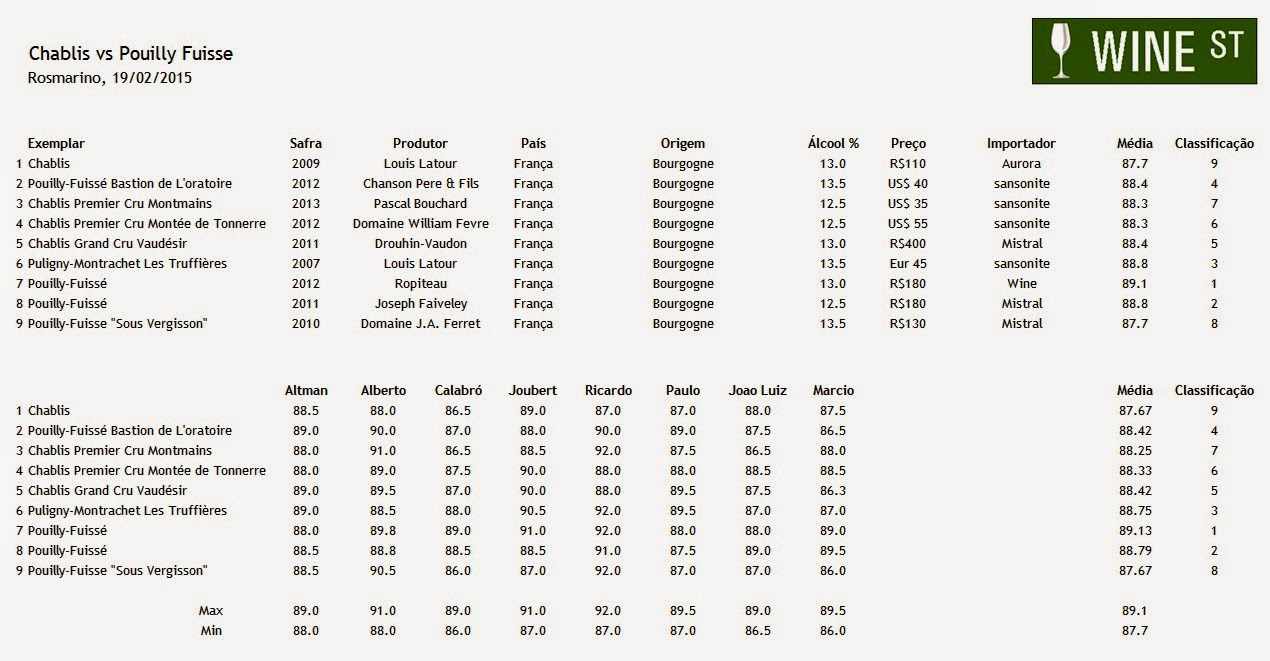
Nesta degustação, os resultados do nosso painel apresentaram, uma reduzida amplitude de notas, sendo na média aparada de 1,5 pontos (de 87,7 a 89,1).

O vinho que ficou em último lugar foi o Chablis 2009, produzido por Louis Latour em Beaune, na Côte-D’Or, com 13% de alcool, escolhido o pior vinho por tres confrades apesar de ter sido escolhido o segundo melhor por outro.

O segundo melhor vinho do painel, foi o Pouilly-Fuissé 2011, produzido por Joseph Faiveley em Nuits-Saint-Georges, na Borgonha, com 12.5% de alcool, escolhido o melhor vinho por dois confrades e o segundo melhor por outros tres.

O Campeão da noite, foi o Pouilly-Fuissé 2012, produzido por Ropiteau Freres em Mersault, na Borgonha, com 13% de alcool, escolhido o melhor vinho para tres confrades, o segundo melhor para outro e o pior para mais um.


Vejam os resultados completos abaixo.


Não se esquecam que no dia 19/Março degustaremos Pinot Noir do Oregon. Até lá....

Não percam a próxima degustação.


domingo, 18 de janeiro de 2015

Gewurztraminer da Alsácia

Na última 5ª feira, dia 15 de janeiro, realizamos no Rufino a primeira degustação do ano, desta vez de vinhos produzidos com a uva Gewurztraminer na Alsácia, com a presença de 6 confrades. Foram degustados 7 vinhos, sendo um Chileno, de safras relativamente recentes (2006, 2007, 2008, 2009, 2010, 2011, 2012 e 2013), O nosso confrade Paulo foi responsável pelo menu da noite.

Couvert: Lula, Grão de Bico, Sardinha Escabeche, Mariscos, pães e manteiga

Prato Principal: Peixe à Rufino’s – pescada Cambucu assada no forno com vinho branco e azeite extra virgem, batatas, cebola, tomates, pimentões e alecrim

Sobremesa: Torta de Chocolate Branco com calda cítrica de Laranja, Torta de Chocolate, Creme de Papaia, sorvete, entre outras

O serviço e a preparação dos pratos estavam excelentes

A degustação contou com sete vinhos de níveis alcoolicos variando entre 13% e 14%.


A seguir uma breve descrição dos vinhos degustados:

Dopff Au Moulin  Reserve 2011
Produtor: Dopff au Moulin
País/Região: França/Alsacia
Graduação alcoolica: 13%
Uvas: Gewurztraminer
Confrade: João Luiz

Gewurztraminer Grand Cru Rosacker 2011
Produtor: Cave Vinicole Hunawihr
País/Região: França/Alsacia
Graduação alcoolica: 13%
Uvas: Gewurztraminer
Confrade: Paulo

Zind Humbrecht Gewurztraminer 2011
Produtor: Domaine Zind Hunbrecht
País/Região: França/Alsacia
Graduação alcoolica: 14%
Uvas: Gewurztraminer
Confrade: Ricardo

Leon Beyer Gewurztraminer 2009
Produtor: Leon Beyer
País/Região: França/Alsacia
Graduação alcoolica: 13.5%
Uvas: Gewurztraminer
Confrade: Altman

Hugel Gewurztraminer 2011
Produtor: Hugel
País/Região: França/Alsacia
Graduação alcoolica: 14%
Uvas: Gewurztraminer
Confrade: Marcio

Santa Digna Gewurztraminer 2013
Produtor: Miguel Torres
País/Região: Chile/Vale Central
Graduação alcoolica: 13.5%
Uvas: Gewurztraminer
Confrade: Marcio

Zusslin Bollenberg Gewurztraminer 2011
Produtor: Valentin Zusslin
País/Região: França/Alsacia
Graduação alcoolica: 13%
Uvas: Gewurztraminer
Confrade: Joubert

Vinhos degustados


Os vinhos apresentaram na sua maioria cor amarelo palha e aromas variados desde frutas brancas maduras, floral e alguns toques minerais.

Nesta degustação, os resultados do nosso painel apresentaram, uma média amplitude de notas, sendo na média aparada de 2,4 pontos (de 86,9 a 89,3).

O vinho que ficou em último lugar foi o Gewurztraminer Grand Cru Rosacker 2011, produzido pela Cave Vinicole Hunawihr na região da Alsacia, na França, com 13% de alcool. Este vinho apresentou aromas mais adocicados, tendo sido escolhido o pior vinho por tres onfrades e o segundo melhor por outro..

O segundo melhor vinho do painel, foi o Zind Humbrecht Gewurztraminer 2011, produzido por Domaine Zind Hunbrecht, na região da Alsácia, na França, com 14% de alcool, escolhido o melhor vinho por um confrade, o segundo melhor por outro e ainda o pior por um terceiro confrade.

O Campeão da noite, foi o Santa Digna Gewurztraminer 2013, produzido por Miguel Torres no Chile, na região do Vale Central, com 13.5% de alcool. Apesar deste ser o coelho e estar fora do tema, foi escolhido o melhor vinho por tres confrades, o segundo melhor por outros tres.


Vejam os resultados completos abaixo.


Não se esquecam que no dia 19/Fevereiro degustaremos Chablis vs Pouilly Fuisse. Até lá....

Não percam a próxima degustação.